
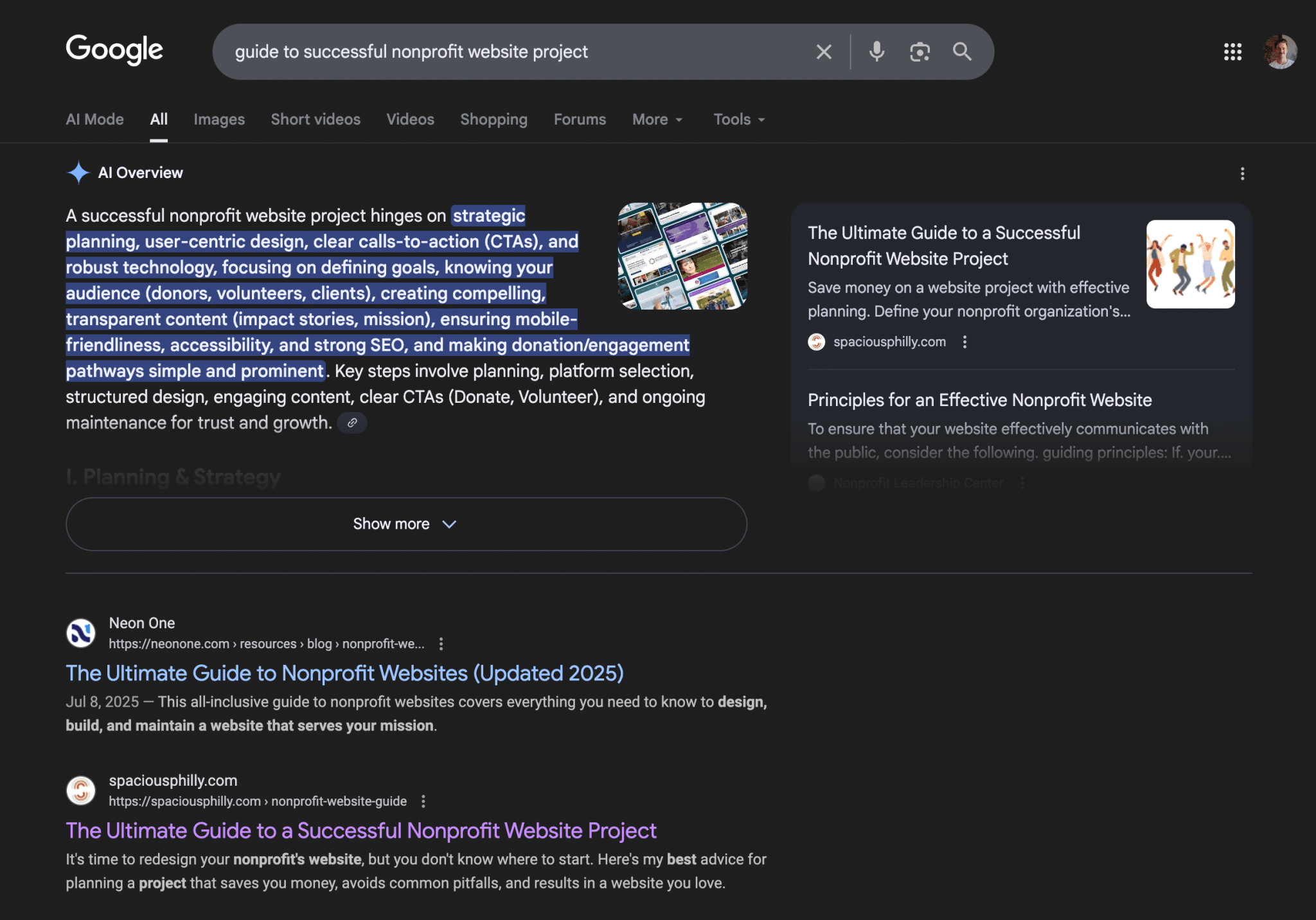
If your organization has relied on blog traffic to reach new people, you’ve probably noticed the numbers dropping. It’s not your imagination—and it’s not your fault.
A recent study by marketing agency Seer Interactive confirms what many of us have suspected: organic click-through rates dropped 61% for queries with AI Overviews, while paid CTRs fell 68%. The study tracked over 3,100 search terms across 42 organizations from June 2024 through September 2025.
That’s not a dip. That’s a fundamental shift in how people find information online.
The informational query is dying
Here’s the core problem: when someone searches “how to start a nonprofit” or “what is fiscal sponsorship,” Google now just… tells them. The AI Overview answers the question right there on the search results page. No need to click through to your carefully crafted explainer post.
Even on queries without AI Overviews, organic CTRs fell 41%. This suggests users are simply clicking less, everywhere.
People aren’t asking fewer questions. They’re just getting answers in new places—Google’s AI summaries, ChatGPT, Perplexity, or social platforms. Your blog post about nonprofit accounting basics is competing against an AI that can answer that question instantly, in whatever level of detail the user wants, without making them wade through your intro paragraphs.
This traffic isn’t coming back. So rather than fighting a losing battle for informational search traffic, it’s time to shift strategy.
Focus on what AI can’t replace: people searching for services
Here’s the good news: when someone searches “web designer for nonprofits in Philadelphia” or “grant writer near me,” they’re not looking for information—they’re looking for a person or organization to hire. AI Overviews can’t fulfill that need.
Service-based searches still work the way they always have. Someone needs help, they search, they find you, they reach out. That’s the traffic worth optimizing for.
What to do instead
1. Optimize your Google Business Profile (free and critical)
This is the lowest-hanging fruit. Your Google Business Profile appears prominently in local searches, and it’s completely free to maintain. Make sure yours is:
- Fully filled out with accurate contact info, hours, and services
- Generating reviews from happy clients (and responding to them)
- Stocked with recent photos of your work
- Updated regularly with posts about your work
Google rewards active, complete profiles with better visibility. If you haven’t touched yours in a year, fix that today.
2. Double down on local SEO
When someone in your area searches for the services you provide, you want to show up. This means:
- Including your service area in your website copy naturally
- Getting listed in local directories and industry-specific listings
- Making sure your name, address, and phone number are consistent everywhere online
- Creating content specific to the communities you serve
3. Optimize your site for conversions, not just traffic
This is the real mindset shift. Instead of chasing high volumes of casual readers, focus on turning the visitors you do get into actual leads and clients.
Look at your website through the eyes of someone who needs your services right now. Can they immediately tell what you do and who you serve? Is there a clear next step for them to take? Is your contact form easy to find and use?
Replace the goal of “more pageviews” with “more qualified inquiries.”
4. Don’t abandon blogging—just recalibrate your expectations
Blog content still has value. It demonstrates expertise, supports your service pages, and yes, still brings in some search traffic. The difference is you shouldn’t expect it to be your primary lead source anymore.
Write posts that showcase your specific expertise and perspective rather than generic informational content that AI can easily replicate. Your unique insights and experience are harder to automate away.
5. Diversify how people find you
Search was never supposed to be your only channel. Consider:
- Email newsletters that build a direct relationship with your audience
- Referral partnerships with complementary organizations
- Social media presence where your audience actually spends time
- Speaking, teaching, or publishing that establishes your authority
If Google’s AI decides tomorrow to answer every question about your industry, you want to have other ways for people to discover you.
The bottom line
The era of generating leads through high-volume informational content is winding down. Seer Interactive’s researchers found that queries without AI Overviews are not increasing in CTR—they’re just declining slower.
The smart move isn’t to try to reverse this trend. It’s to shift your focus toward quality over quantity: fewer visitors who are actually looking for what you offer, rather than thousands of casual readers who were never going to become clients anyway.
Get your Google Business Profile in shape. Make sure your website converts. Build relationships outside of search. And accept that the rules have changed.
The organizations that adapt will do just fine. The ones waiting for traffic to bounce back will be waiting a long time.
